
Ovis Aries
A short lyric essay by Sonny Walker


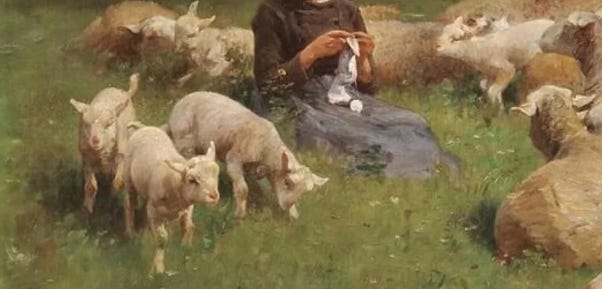
I was twenty the first time I dissected a sheep’s eye. As part of an animal sciences degree, a group of seven of us adorned white coats, stood distant from one another in a cool-toned lab, and wielded scalpels. We sliced through flesh like amateur butchers, scrunching our noses at the smell of the beginnings of decay. They were harder than expected, the eyes, like marbles preserved in jelly. Frogspawn came to mind. Have you ever chewed an undercooked tapioca pearl?
My lecturer asked, while holding up the eye in line with his own, “Does anyone know why the pupil is rectangular?”
Nobody spoke, including me, who froze like a goat with fear. I confess I knew the answer: sheep (Ovis Aries) are prey animals, and the extended pupil lets them scan the grassy fields they roam for predators. When our silence stretched long enough, my lecturer answered for us, “It widens their field of vision.” He went on to explain that even when the sheep bows its head, the long edge of the blackness remains parallel to the planes. I tested it, holding it in my hand and twisting my wrist, watching it fail to align with any such angle. With all those flecks of dark feathering from a vaguely rectangular centre, the pupils resembled the spiked caterpillars of the Giant Leopard Moth (Hypercompe Scribonia) or a Sea Urchin (Diadema Antillarum), elongated. A void, unsettled, reaching outwards from itself and towards me. It didn’t look away. Neither did I.
Fascinating, you might say. So what are you doing here? Shouldn’t you be collecting samples of jellyfish or something?
Had I not dropped out of that degree, I’d certainly be ankle-deep in rock pools, cutting the arms of starfish for population control like some God. I’d have been there when the fin whale washed up on Fistral, cutting up its body for research, hauling great chunks of pink meat into buckets in an effort to figure out what went wrong. It was my safety net, the ‘realistic’ option for a nature-loving poet in a world choking out the arts, but my faux-passion for the data and beakers dissolved like whalefall. It was dark, and I was cold. For the warmth of spring, I slowed, I stilled, and I let myself change. I wrote, and wrote, and wrote like an animal.
Change is nature; nature changes. What is relinquished to the elements is repurposed, and what can’t be relinquished is reclaimed; flesh rots, metal rusts, seas recede; stars become suns, sons become daughters. The ewe skips and prances and dances through grasses that turn from yellow to white to green, and I, too, shift from lamb to man, or something man-adjacent—the pupil parallel to the earth, the urchin.
My deadname is Ewe, ‘innocent’ in Hebrew. I’m entrusting that to you, which I changed before starting that animal sciences degree. For this, the erasure of the pure, they called me Butcher. They said the hand that holds the syringe is the hand that holds the cleaver.
I maintain that to change is not always to destroy or overthrow; things can grow. What doesn’t decay becomes a home. “Those biology classes had to be for something,” I tell my Mother, drawing Testosterone cypionate through a needle. I wipe my thigh with a clinical wipe and let the surface air-dry the way my lecturer taught me after we’d dissected that eye. I say, “You have a choice: dead daughter, or shining son.” Greedy, she chooses both; the maker makes me lamb and handler, meat and eater, makes me grieved while I am growing. She made me something incomprehensible, something holy. From there, the tissue of my old body: fireflies. They climb the sky, settle into the grooves of the great black blanket and blink. They squeeze, and squeeze, until they burst, and light pours from night into day.
I used to laugh in birdsong. I laugh, now, in bars of honey and egg yolk; it pours out of me, sunlight over fields of sheep. It feeds, sustains, sinks golden into abandoned burrows and fills, and fills.
No harm came to me, no cleaver nor scalpel in shaking, unpractised hands like ours in that harsh laboratory; there was only kindness. The hand that holds the syringe is the hand that holds the staff is the hand of the shepherd, guiding milk-fed bodies into nourishing light, into honeycomb grasses, into home.
I confess I still see myself in those grazing creatures, in their urgent, wide-eyed submission as they buckle under a firm hand. If a man held my head between his thighs, I, too, would stop kicking.
Thank you for being here! Teiresian is a tiny, independent press led entirely by trans artists & writers. A special thanks to our paid subscribers, who provide us with another stream of income to support future publications, from buying beautiful paper to print on to paying the trans artists we work with. You can become a paid subscriber from £3.50/month or £20/year, and in return you receive an extra essay every month. Alternatively, you can support us by buying our publications or making a one-off donation to our ko-fi.
 | A guest post by
|