
Thin is back
How much later does late stage capitalism get before we all just lay down and die?


Thank you for being here! Teiresian is a tiny, independent press led entirely by trans artists & writers. A special thanks to our paid subscribers, who provide us with another stream of income to support future publications, from buying beautiful paper to print on to paying the trans artists we work with. You can become a paid subscriber from £3.50/month or £20/year, and in return you receive an extra essay every month. Alternatively, you can support us by buying our publications or making a one-off donation to our ko-fi.
I just feel I’m a better person.
client testimony from this Juniper ad (psst… I’m linking it because it’s a source, but please don’t waste time watching it)
Recently, I haven’t been able to open Instagram or YouTube without seeing weight loss ads. I don’t follow any accounts that encourage weight loss, or even any fitness accounts, but the algorithm is holding open my jaw and choking me with GLP-1 drugs until my hair falls out.
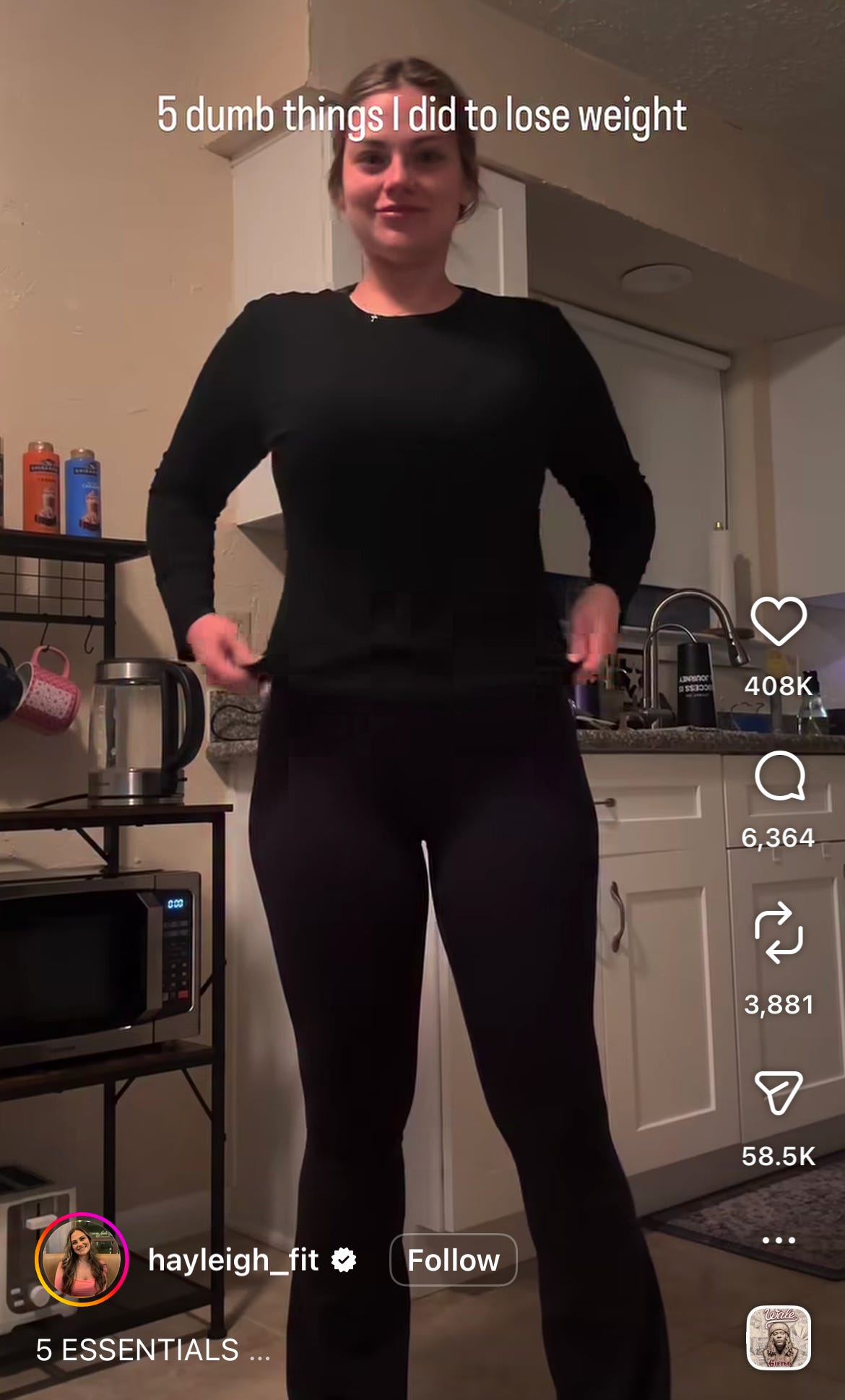
I feel myself slide back into the mindset of 10 year-old me, eating a satsuma for breakfast instead of the toast I wanted because I thought I had to lose weight. I was a fat kid, and I still feel the mockery that comes with that. I thought I had moved past the phase where I scan photos of myself for a double chin, for the visible shape of my stomach, for the size of my arms, but I haven’t. In the past couple of years, it’s all come rushing back.
Ultimately, this essay is going to be from the perspective of someone who grew up as a girl in the 2000s, the peak of diet culture and shaming women for their size — and who is still often perceived and treated as a woman (hello, that’s me). Cis men are not exempt from today’s thin obsession, though for them it often shows up in desperation for muscles, for the appearance of strength and, therefore, masculinity. I hope to see more cis men covering this topic soon, as I’d be interested to hear their perspective.
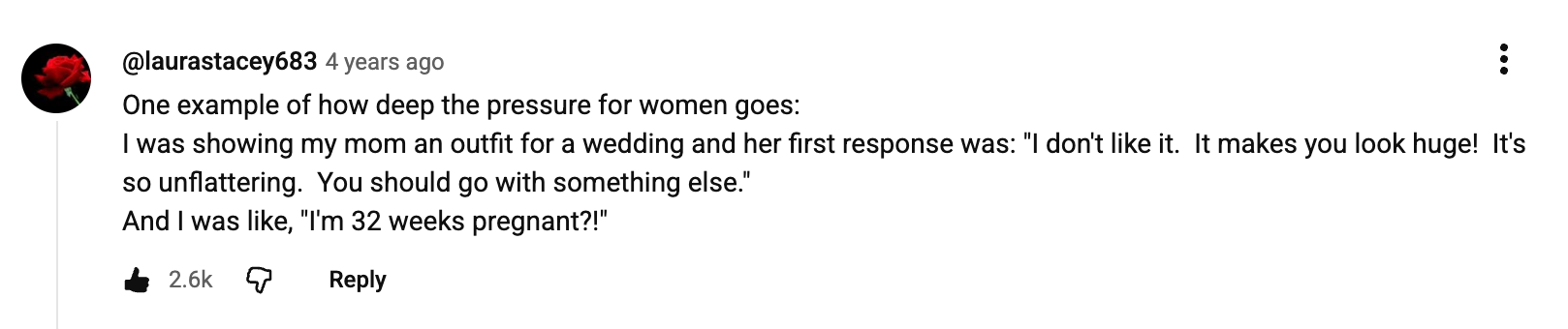
In her video essay Food, Beauty, Mind, Abigail Thorn of Philosophy Tube investigates the philosophy of food, subjectivity, and morality. Towards the end of the video, she makes the point that for a man to finish a big meal is a victory, while for a woman it’s a failure. This really hit home for me. My grandma always complains about her portions being too big, often looks at other people’s (women’s) plates around the table and comments on how much they’re eating, asks for the tiniest sliver of cake. My mum never finishes her meals, says stuff like ‘we won’t need dinner after this!’, and serves herself the smallest portions. Because eating is a moral failure. It’s gluttony, it’s disgusting, it’s unfeminine.
Thorn points out that, for women, fatness is connected with masculinity. Fatness disqualifies you from womanhood, especially if you’re trans and/or Black. She describes the Panopticon, the idea of a prison with a central watchtower that can see into every cell, where you never know if you’re being watched so you assume that you are always being watched and behave accordingly, effectively surveilling yourself. When it comes to food, women have been taught to regard themselves with ‘discipline and surveillance’ (19:06).
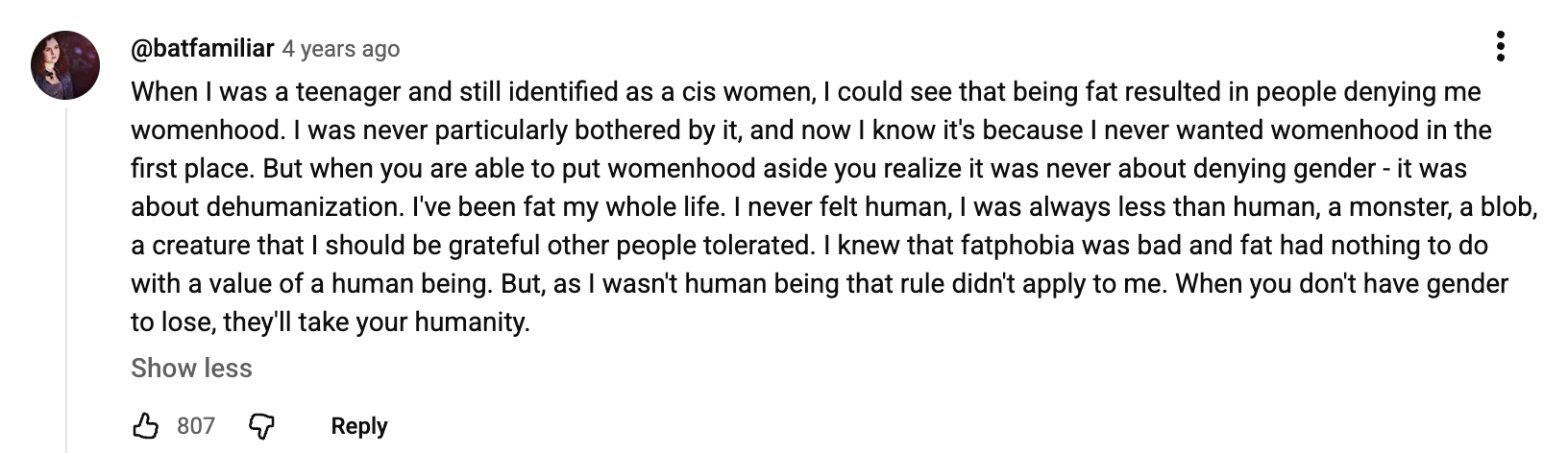
In a move that makes me want to scream, Juniper, the weight loss company we’ve all been seeing ads for across social media, acknowledges this problem. They cite heartbreaking research that has found that ‘24% of women have set a weight-loss resolution more than five times’, and that ‘72% [of women] are considering GLP-1 medications like Mounjaro or Wegovy [the medications offered by Juniper] to support their goals’1. What I’m not doing is shaming anyone who has used these medications, whether they were prescribed by a GP for health reasons or ‘prescribed’ by weight loss companies like Juniper for aesthetic reasons. No individual is responsible for this situation, and we all have a right to choose. I know how much it hurts to have a body that feels so completely wrong that you want to tear off your skin, and I’m the last person to judge anyone who messes around with their hormones. Moreover, as fat writers including Lizzo have pointed out, fatness comes with a very real cost.
So here we are halfway through the decade, where extended sizes are being magically erased from websites. Plus sized models are no longer getting booked for modeling gigs. And all of our big girls are not-so big anymore.2
There’s a genuine financial cost to being fat today. It’s harder to find clothes, harder to get jobs.3 But there’s also another, even more frightening, cost — a medical cost. The National Library of Medicine recounts the story of Ellen Maud Bennett, a fat woman who died in 2018 after her doctor ignored symptoms that she had been experiencing for several years, attributing them to her size. It turned out to be cancer, and by the time this was diagnosed they gave her days to live.4 With the odds stacked against them, can we blame fat people, especially fat women, for wanting to be thin?
During COVID, medical fat shaming increased along with eating disorders, under a new guise of looking after your health.5 This is what I think makes the weight loss industry dangerous today: they tell you it’s not about weight, it’s about health — weight loss is just a nifty side effect. In this way, the weight loss industry is like a virus that has adapted to medication (the medication being, perhaps, the fleeting success of the body positive movement of the mid-late 2010s).
[Medicine] relocates desire into treatment, ambition into compliance. This isn’t about beauty anymore; it’s about health, balance, inflammation, blood sugar, longevity. When thinness can be explained as treatment rather than desire, there’s nothing left to justify, confess, or debate.
- ‘The return of thinness, without the reckoning’ by Amanda Richards from fat hell on Substack
In disguising the reach for thinness as a desire to be healthy, weight loss companies make thinness apolitical. Surely everyone wants to be healthier. Whether or not it’s good to be healthy can’t be up for debate.
Except it’s not about health. Weight loss, like most things, comes back to capitalism.
Juniper’s core team as shown on their website is almost entirely composed of men. The only woman is a dietitian, not even one of their licensed doctors — Juniper’s intention is apparently ‘to redefine the way women manage weight gain’, so why isn’t their team led by women?6 Sure, you don’t have to be a woman to treat women, but with the history of medical misogyny would it not be a good idea to heavily involve women in your team focusing on women’s health?
The BBC investigated Juniper in 2025 and found it riddled with unsafe practices.7 For one, it was incredibly easy to lie and get hold of medication.
“All I had to do was fill out a simple questionnaire about my weight. I did lie about my weight just to meet the threshold… and I got the pen within 24 hours.”
Then come the side effects. There isn’t much long term research on these medications, so ultimately there are a lot of unknowns. However, very common side effects of Wegovy (experienced by more than 1 in 10 people) include headaches, vomiting, diarrhoea, and stomach pain8; and very common side effects of Mounjaro include vomiting, diarrhoea, and constipation.9 Undercover reporters from the BBC were able to get hold of these medications from Juniper by lying about their health ‘despite regulatory rules designed to prevent this’.
Now, obviously, people (especially women) are prescribed medication with intense side effects all the time. I didn’t even bother reading the extensive list when I went on birth control. I’ve taken testosterone, sertraline, fluoxetine, and more, and I’m not about to proclaim that we shouldn’t take medication that we need because it might make us sick. For some people, it’s a risk they have to take. The problem, once again, is not the people taking this risk — it’s the companies profiting from their desperation.
My problem with Juniper is not that they’re prescribing medication, but that they’re taking advantage of our crumbling healthcare system and our biggest vulnerabilities to drain people’s bank accounts. In the middle of an immense economic crisis. And they’re not only taking advantage of our vulnerabilities; they’re creating new insecurities. That’s what the ads are for.
Returning to Thorn’s video essay, she makes the point that adverts by weight loss companies are designed to create demand. Companies rely on demand to sell their goods, and where there is no demand they have to create it. They tell you you’re fat, you’re lazy, you’re unhealthy… and that they can fix it.
According to philosopher Simon Critchley, we have two selves: the self that we experience and the ideal self that we feel we should be. Critchley says that we can never reach our ideal self; it would upset our balance, as we always need something to strive for.10 Adverts mess with our ideal selves. They offer us new aspirations: be thin, be sexy, be fit. Then they offer us products that they say will draw us closer to our ideal selves.
Karl Marx called this commodity fetishism: the way that we worship commodities and assign almost magical powers to them. If we have them they will make us happy, or sexy, or young again.11 And it goes further than aesthetics and quality of life. We’re told that our weight reflects on our morality.
The ideal self is also, according to Critchley, where we find our morality. We strive to be beautiful, intelligent and funny, sure. But we also strive to be good. At the beginning of this essay I took a direct quote from an advert by Juniper, featuring supposedly happy customers, which I’m going to repeat now.
I just feel I’m a better person
Deep down, we’re all little kids who want our parents to tell us we’re good.
Right now, there is so much in the world that we can’t control, and so much suffering that we feel helpless to stop. Every morning I wake up and feel like the world is ending. Capitalism has alienated us from one another, like Marx said it would. It has fed individualism, the idea that it’s ‘every man for himself’. We feel hopeless. So we turn on ourselves, grasp for the things we can control in a world that is run by the 1%.
We can’t quit our jobs to create art, travel the world, spend time with our families, end wars, but we can exercise until we pass out, eat the smallest portions, drink black coffee to whet our appetite, buy the shitty drugs to make us forget we’re hungry. Fatness, we’ve been taught, is immoral. It’s a symbol of greed, of gluttony and laziness. As with all things, class comes into this. Fatness is associated with poor people, with people on benefits, and it’s seen as a visible depiction of failure. All we want is to be good and for other people to tell us we’re good. And we want something to control when we feel so alone and so helpless.
So of course we turn to our bodies, and of course companies lean into this idea of thinness = goodness. It’s as depressing as it is predictable.
I don’t think this essay reads as optimistic, and I feel regretful of this. I don’t want you to read this and feel like shit. I hope it’s provided catharsis for some of you. Part of me wants to end with a proposed course of action, but who am I to tell you what to do? If you want to do something nice for your community or the world, that’s fantastic. Mostly, I think you should treat yourself with kindness and eat the fucking biscuits when you want them, even (especially) if you get a little softer as a result.
Menenti S. (2025), New year, new you? How to lose weight for the last time in 2026, Juniper
Lizzo (2025), Why is everybody losing weight and what do we do? Sincerely, a person who’s lost weight, Substack
Alsop R. (2016), Fat people earn less and have a harder time finding work, BBC Worklife
Kost C., Jamie K. & Mohr E. (2024), “Whatever I said didn’t register with her”: medical fatphobia and interactional and relational disconnect in healthcare encounters, National Library of Medicine
Gamble I. & Tonic G. (2025), Skinnytok, Crunchy Teens, & The Return Of Pro Ana Content, Polyester podcast
Seery C. (2025), BBC investigation reveals online pharmacies Juniper and MedExpress bypassed rules, Diabetes.co.uk
Ikeji B. (2025), Wegovy side effects: What you need to know, ASDA Online Doctor
Miller Z. (2024), Mounjaro side effects, ASDA Online Doctor
Thorn A. (2021), Food, Beauty, Mind, Philosophy Tube
Lasky J. (2024), Commodity fetishism, EBSCO
 | A guest post by
|
Wonderful essay!! Very informative 🙏🏻